When strong light hits a digital sensor, voltage registers linearly until the pixel well overflows, instantly flattening texture into lifeless pure white. Photographic film responds through a gentle logarithmic shoulder where silver halide crystals saturate progressively. Understanding this photochemical curve explains why analog highlights retain dimensional texture where digital sensors produce harsh clipping artifacts.
The Hurter & Driffield Characteristic Curve
In 1890, British chemists Ferdinand Hurter and Vero Charles Driffield published a foundational methodology for measuring photographic sensitivity: the D-log E curve, known as the characteristic curve. By plotting optical density (D) on the vertical axis against the logarithm of exposure (log E) on the horizontal axis, Hurter and Driffield revealed the distinct S-shaped response of photographic emulsions. This curve divides into three primary regions: the toe, the straight-line portion, and the shoulder. In the toe region, low levels of exposure produce minimal density above the base-plus-fog level. As light intensity increases, the curve transitions into a steep, straight line where density increases proportionally with the logarithm of exposure. The slope of this straight line defines the film contrast, termed gamma.
A distinctive response occurs at the upper boundary of the straight-line portion: the shoulder. Instead of continuing upward indefinitely or terminating abruptly, the curve bends smoothly into a horizontal plateau known as maximum density (D-max). In a typical modern color negative stock like Kodak Portra 400 or Fujifilm Pro 400H, the shoulder spans three to five additional stops of overexposure beyond middle gray. Even when a bride's white silk dress or a specular glint on chrome car trim receives ten times the nominal exposure of the scene, the emulsion compresses these extreme luminance values into subtle, gradated steps of silver density. The film negative absorbs the surge of photons gracefully, preserving the micro-texture of woven fabric and metallic contours where a digital frame would record only flat, vacant white.
Photochemical Grain Saturation versus Silicon Potential Wells
The physical mechanism separating film highlights from digital capture lies in the physics of light-sensitive receptors. A digital image sensor consists of a two-dimensional grid of silicon photodiodes. Each photodiode acts as an electronic bucket, technically termed a potential well, with a finite full-well capacity typically rated between 20,000 and 60,000 electrons. Incoming photons striking the silicon liberate electrons through the photoelectric effect. These electrons collect within the potential well in a strictly linear ratio: doubling the incoming photon count doubles the collected charge. When the potential well fills completely, it reaches full saturation. Any additional photons cannot generate recorded voltage. The analog-to-digital converter (ADC) registers the maximum possible integer value—4095 in a 12-bit readout or 16383 in a 14-bit readout. The transition from active data to hard clipping occurs across an infinitesimal fraction of an exposure stop, creating a sharp, unnatural boundary.
| Characteristic | Photochemical Emulsion | Digital CMOS Sensor |
|---|---|---|
| Response Curve | Logarithmic S-curve with progressive shoulder | Linear voltage response until full-well limit |
| Saturation Mechanism | Asymptotic crystal exhaustion across grain sizes | Abrupt electron overflow in silicon potential wells |
| Overexposure Behavior | Gradual desaturation toward pure luminous white | Hard channel clipping producing chromatic distortion |
| Highlight Latitude | +3 to +5 EV retention beyond middle gray | +1.5 to +2.5 EV before unrecoverable clipping |
Silver halide emulsion operates on stochastic statistical distributions rather than uniform electronic grids. A single sheet of 35mm film contains billions of microscopic silver halide micro-crystals suspended in animal gelatin. These crystals vary widely in physical size; modern tabular grain (T-Grain) and cubic emulsions blend small, medium, and large crystals across multiple coated layers. Larger crystals possess a larger surface area and capture photons at lower exposure levels, while smaller crystals require significantly higher photon flux to form a stable latent image center of four reduced silver atoms. As exposure climbs into intense highlights, the large and medium crystals fully develop into metallic silver, leaving fewer and fewer unexposed small crystals available for capture. The probability of an incoming photon striking an unexposed crystal decreases asymptotically. This statistical exhaustion creates natural shoulder compression through quantum mechanics, eliminating the concept of a sharp clipping threshold.
Color Crossover and Channel Desaturation at Extreme Densities
Highlight clipping in digital systems causes severe chromatic distortion before total luminance failure occurs. Digital sensors capture color by placing red, green, and blue dyes over individual photosites in a Bayer mosaic pattern. Because human visual sensitivity peaks in the green spectrum, camera sensors allocate twice as many green photosites as red or blue, and raw processing algorithms balance white points by scaling digital channel gains independently. Under warm incandescent lighting (2800K to 3200K), the red channel reaches full-well capacity long before the green and blue channels. When the red channel clips while green and blue continue to record exposure data, the camera processor miscalculates the color balance of bright areas. Clouds illuminated by golden hour sunlight turn neon yellow or radioactive magenta at the rim where one channel maxes out while others remain linear.
Photographic film handles highlight color through natural desaturation rather than channel skewing. In a multilayer color negative, intense highlight exposure develops dense metallic silver across all three dye-forming packs (yellow, magenta, and cyan). During lab development, inter-image effects and development-inhibitor-releasing (DIR) couplers slow down dye coupling in heavily exposed zones. As the negative approaches maximum density, the transmission of light through the three dye layers balances out, rolling smoothly toward clean, uncolored white. Instead of shifting toward an unappealing hue, the color naturally desaturates toward a soft, luminous white. Sunlight gleaming off ocean waves or polished chrome fades into white without the garish magenta fringing or green halo artifacts common to digital overexposure.
Mathematical Shoulder Modeling in GLSL Fragment Shaders
Emulating film shoulder compression in digital software requires mathematical functions that replace linear clipping with continuous asymptotic roll-off. Standard linear clamping functions like `clamp(x, 0.0, 1.0)` in shading languages cut off highlight data abruptly at 1.0, creating the very digital aesthetic photographers seek to avoid. Simple Reinhard tone mapping curves like `x / (1.0 + x)` compress highlights effectively, but compress the midtones excessively, robbing the image of contrast and punch. To authentically replicate the Hurter & Driffield curve, modern computational color models employ rational splines or generalized Naka-Rushton equations that maintain linear behavior through midtones while introducing smooth logarithmic compression above a defined shoulder threshold.
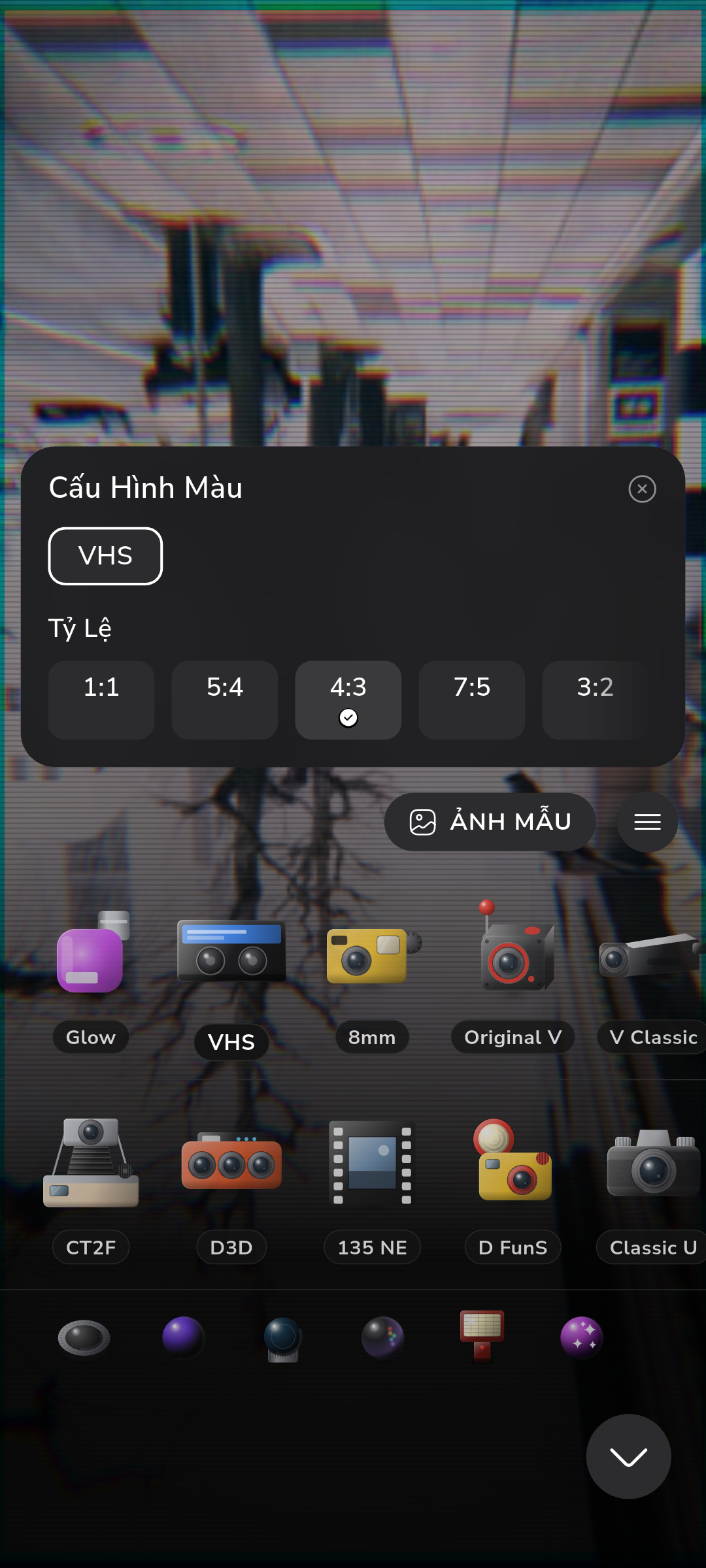
In RfCamera, this highlight response is computed dynamically inside the custom GLSL fragment shader (`shaders/film.frag`). Operating directly on the device GPU, the shader converts incoming linear photometric values into logarithmic space. It applies a cubic Hermite spline across the transition zone starting at 65% luminance, ensuring continuous first- and second-order derivatives. This mathematical smoothness guarantees that highlights curve gracefully toward the maximum display ceiling without visible inflection banding. Furthermore, the shader evaluates luminance independently across RGB vectors, softly pulling chromatic saturation down as luminance approaches the white point. The live viewfinder in `widgets/film_view.dart` renders this film shoulder at 60 frames per second, allowing photographers to compose backlit portraits and direct sun flares with immediate visual certainty.
Isolate Pipeline Execution and Offline Hardware Security
Executing advanced optical simulations in real time presents substantial computational demands on mobile processors. If tone-curve evaluations, procedural grain blending, and optical aberration passes were processed directly on the main application isolate, the smartphone interface would suffer stutter, frame drops, and input lag during camera operation. RfCamera resolves this architectural constraint by dividing tasks cleanly between live display and final output rendering. The live camera preview relies on hardware-accelerated OpenGL and Vulkan texture rendering through Flutter's custom shader pipeline, delivering instant visual feedback with minimal CPU overhead.
When the shutter fires, the full-resolution capture is handed over to `core/bake.dart`, which orchestrates a dedicated Dart `compute()` background isolate. Raw pixel buffers pass to the worker isolate as zero-copy byte arrays, preventing heap spikes and memory fragmentation. This secondary thread executes the complete Hurter & Driffield shoulder curve across the entire multi-megapixel image matrix, applies procedural grain scanned from real silver halide film plates, and renders optical barrel distortion and edge chromatic aberration without touching the user interface. Because the isolate runs in native background memory, you can continue shooting successive frames without waiting for a processing spinner. This architecture operates with strict determinism on local hardware: RfCamera declares zero internet permissions in its application manifest, transmits no telemetry packets, and writes finished JPEGs straight to the application documents directory without relying on external cloud infrastructure.