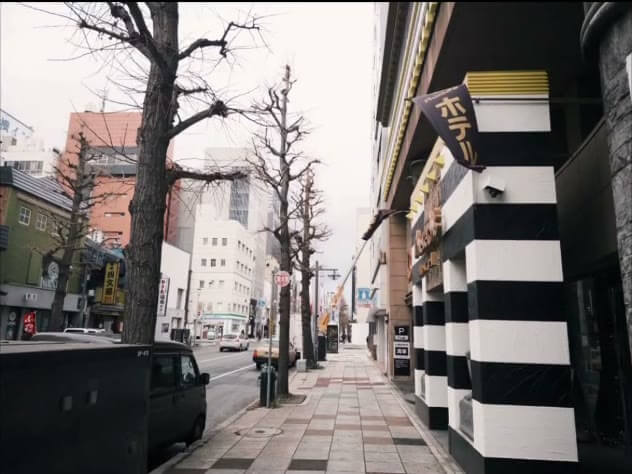
Golden hour light at 3000K is not the same light as noon at 5500K with a warm filter over it -- the color temperature itself has physically fallen as the sun's angle flattens. Here is how that light behaves, and the exact FXN 35mm settings that render it without cooking skin tones into mush.
Why Sunset Light Turns Orange, Not Just Dimmer
Sunset light does not just dim as the sun drops -- its color temperature falls from roughly 5500K at midday daylight balance down to 3000K, sometimes below 2000K, in the final few minutes before the sun disappears. That shift is pure atmospheric physics, not a filter effect. As the sun's angle flattens toward the horizon, its light has to travel through a much longer column of atmosphere to reach your lens than it does at noon, when it drops almost straight down. Rayleigh scattering knocks short blue wavelengths sideways out of that longer path far more aggressively than it does long red and orange wavelengths, so the light that survives the trip is disproportionately warm. This is the same mechanism that turns the sky itself orange and red near the horizon while it stays blue overhead -- the blue photons scattered away from the sun's direct path are what you see as blue sky elsewhere, and the reddish leftovers are what reach your subject head-on. A camera or film stock balanced for 5500K daylight will read this 3000K light as a strong warm cast, because it is one: the light itself has genuinely changed, not just its intensity. That is why golden hour photographs feel different from a shot taken at noon and simply darkened afterward -- the color information hitting the sensor or emulsion is shifted toward red-orange at the source, and skin tones, brick, and foliage all pick up that cast simultaneously rather than each channel just dimming by the same amount.
How RfCamera Renders the Warm Shift in Real Time
RfCamera renders that warmth through the same FilmEffect pipeline whether you are watching the live viewfinder or reviewing the photo you just took, which is the detail that makes the app usable for fast-moving golden hour light. The viewfinder path in widgets/film_view.dart applies a colour matrix first -- this is where the warm push happens, shifting the red channel up and pulling blue down to emulate the dye response of a given film variant -- and then runs the frame through a GLSL fragment shader (shaders/film.frag) that adds barrel distortion and chromatic aberration to emulate the behavior of a real lens rather than a flat digital sensor. Grain, light leaks, dust, scanlines, vignette, and the date stamp are layered on top of that as overlays, each drawn from real scanned film artifacts rather than generated procedurally. The important part for golden hour shooting is that nothing about this changes when you press the shutter: core/bake.dart replays the exact same colour matrix and shader math inside a compute() isolate on-device to produce the final JPEG, so the warm, slightly aberrated frame you saw while composing is what actually gets written to your app's documents directory, not a rough approximation of it. That matters more at golden hour than at any other time of day, because the light is changing minute to minute and you need the preview to be trustworthy rather than discovering afterward that the saved file looks different from what you framed through the lens.
The Tokyo Golden Hour Recipe
For the Tokyo Golden Hour look specifically, the FXN 35mm profile set to its Warm 80s variant pushes white balance about 1800K warmer than neutral, which is enough to turn a plain concrete street orange without cooking skin tones into a red mess the way an unchecked warm shift would. Halation is set higher than usual, around 24 percent, because backlit highlights -- streetlights just switching on, chrome, wet pavement -- need that soft bloom around their edges to read as film rather than as a harsh, blown-out digital highlight with a hard clipped edge. Grain stays comparatively fine at 16 percent so faces and hands don't get swallowed by texture when the frame is already busy with warm color and bloom competing for attention. The amber date stamp in the lower right corner is a deliberate nod to consumer point-and-shoot cameras with data backs from the late 1980s, where an orange-tinted LED stamp was the factory norm rather than the now-familiar red one most people associate with disposable cameras today.
These four values work together rather than independently: raise white balance too far past 1800K and the halation bloom starts to look muddy orange instead of luminous, drop grain below roughly 12 percent and the frame starts to look digitally smoothed despite the warm cast, and push halation past 30 percent and highlights lose their shape entirely into flat glow. The combination above is tuned to sit right at the edge where the frame still reads as a specific photograph of a specific street rather than a uniform orange wash, which is the difference between a golden hour shot that looks considered and one that looks like a preset was slapped on top of an ordinary daytime frame.
Metering Into the Sun Without Losing Your Subject
The usable window for this look is short, typically 20 to 40 minutes before actual sunset, and metering into the sun forces a choice you don't face at midday: the sky behind your subject can be five to six stops brighter than a face lit only by ambient bounce and the last of the direct warm light. If your camera's automatic metering averages the whole frame, it will expose for that bright sky and drop your subject into a near-silhouette with no recoverable detail. Spot metering on a subject's face or a midtone surface nearby, then dialing in roughly -1 to -1.5 EV of compensation once you turn back toward the brighter sky, keeps skin tones readable while letting the highlights bloom into halation rather than clip to flat white with no gradation. Shooting at box speed rather than pushing the stock gives you that extra stop and a half of highlight headroom to work with when the dynamic range gets extreme. Once the sun actually touches the horizon, the color temperature keeps falling and the light drops fast enough that a shot taken ninety seconds later can look noticeably different -- warmer, dimmer, more red -- than one taken at the start of the window, which is why golden hour shooting rewards working quickly through a sequence of frames and compositions rather than lingering too long on any single one waiting for it to feel perfect.
Why Warm Casts Are Baked Into Old Consumer Film Chemistry
The warm cast associated with late-1970s and 1980s consumer color film is not purely a stylistic choice manufacturers dialed in on purpose -- part of it is chemistry that happens whether anyone wants it to or not. Color negative film carries three light-sensitive layers stacked on top of each other: a blue-sensitive layer that develops a yellow dye during processing, a green-sensitive layer that develops magenta, and a red-sensitive layer that develops cyan. Cyan dye couplers used in mass-market consumer stocks of that era were chemically less stable than the magenta and yellow couplers sitting above them in the emulsion stack, so as a roll aged on a drugstore rack or sat in a family fridge for years, the cyan layer degraded fastest of the three. Because cyan is the complementary opposite of red on the color wheel, losing cyan density pushes the overall image warmer and redder even though nothing physically happened to the red or yellow layers themselves. On top of that baseline chemical instability, consumer emulsions were also tuned deliberately at the factory to flatter skin tones in ordinary family snapshots, which meant a warm bias was often built in from day one rather than purely acquired with age over the following decades. The "warm 80s" look people chase today is really the sum of both effects layered together: an emulsion designed from the start to be forgiving on faces, aging in a direction that pushed it even warmer as the years went by.