The Additive Physics of Latent Image Formation
In physical film photography, a double exposure is created by intentionally exposing the exact same 36x24mm rectangle of silver halide emulsion to light twice before advancing the roll. At the atomic scale, latent image formation is an irreversible additive process: photons striking silver bromide crystals release electrons that reduce silver ions (Ag+) into sub-microscopic clusters of metallic silver (Ag0). Each successive exposure can only add further silver nuclei; it can never subtract or erase what has already landed.
This fundamental law dictates that any section of the frame exposed to pure white in the first shot has exhausted its available silver halide. When the second shutter fires, no further latent density can form in those burned-out regions. Consequently, double exposure composition is not about stacking two complete pictures — it is about orchestrating light in one image to fill the darkness of another.
Silhouette Masking and Exposure Compensation Rules
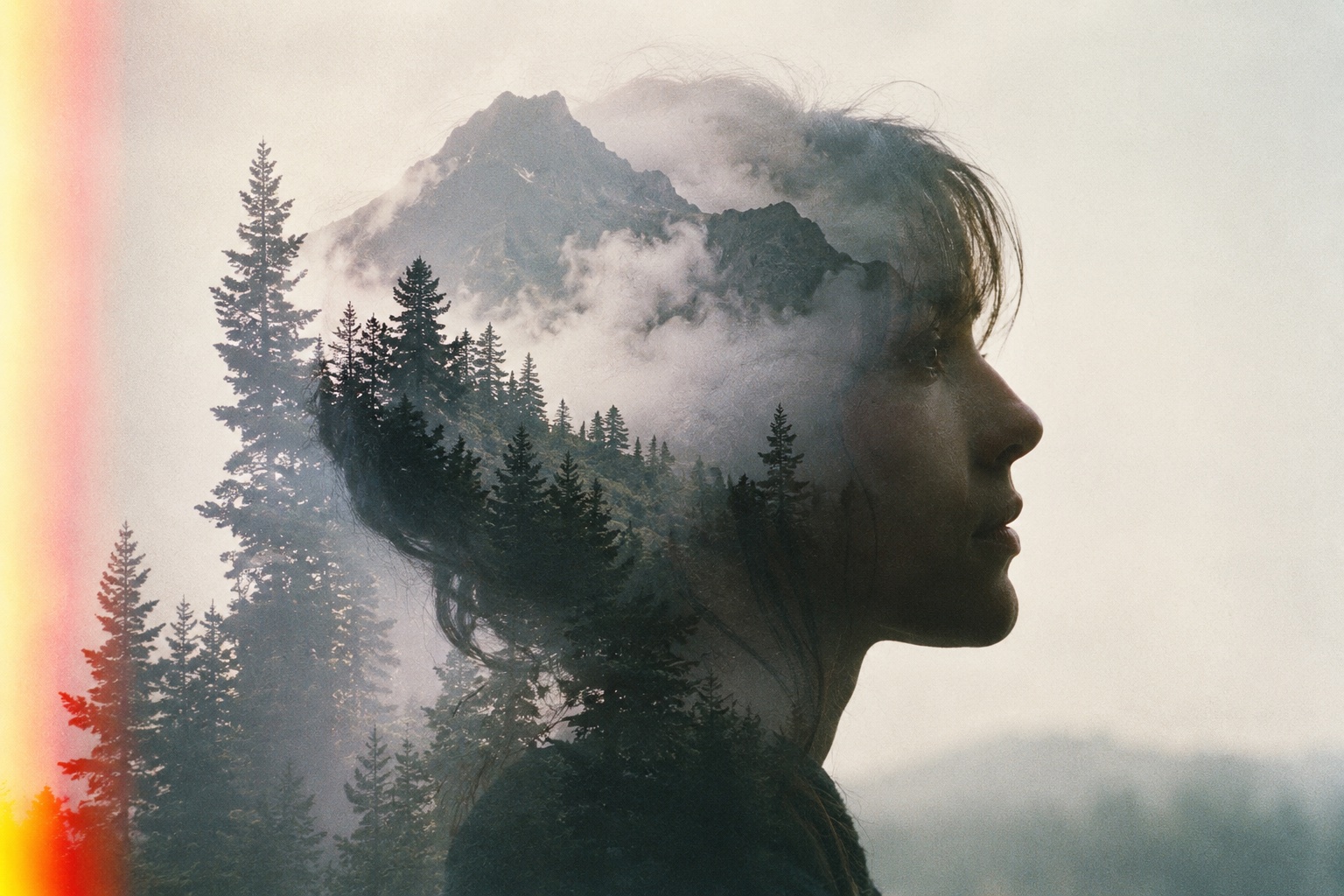
The most effective double exposure compositions utilize a stark silhouette as an organic stencil. Photographing a model directly against a bright sky or window casts their face and torso into deep shadow. These underexposed dark areas leave the underlying silver crystals untouched, creating a pristine canvas primed to record the textures, trees, or city architecture captured during the second shutter release.
To maintain correct overall density across the final negative, photographers apply the rule of exposure compensation: shooting both exposures at nominal box speed results in an overexposed negative (+1 EV total exposure). Setting your camera's exposure compensation dial to -1 EV for both shots ensures that when their respective photon counts combine, the resulting negative lands precisely on the linear portion of the film's characteristic curve.
Real-Time Ghost Layering with RfCamera
Executing double exposures on mechanical film cameras historically required delicate guesswork and nerve-wracking film rewinding tricks that often misaligned frame edges. RfCamera eliminates the blind trial-and-error while preserving the authentic physics of optical blend modes.
After taking your first frame, the app renders a subtle semi-transparent ghost preview over your live rangefinder viewfinder. You can leisurely pan, tilt, and frame your second subject — aligning a distant skyline into the hollow of a silhouette with pinpoint compositional precision before committing to the shot.