The double-clack of a leaf shutter or the motorized whine of a Polaroid ejecting isn't incidental noise. It's feedback your hand and ear register as confirmation that something real just happened, and it changes how carefully you frame the next shot.
The Anatomy of a Leaf Shutter Click
A leaf shutter click is not one sound — it's two. Inside a mechanical leaf shutter, a ring of thin metal blades (usually five to seven, machined from spring steel or beryllium copper) sits between the lens elements. Pressing the release trips a spring-loaded lever that snaps the blades open, exposes the film for a fixed interval set by a gear train or electromagnet, then snaps them shut. That's the double-clack: one click for open, a near-simultaneous click for close, separated by however many milliseconds the shutter speed dial demands. At 1/500s the gap is too short to hear as two events; at 1/8s you can count the beats. Leaf shutters live in the lens barrel itself — Copal, Seiko, and Compur made most of the units found in classic rangefinders and folding cameras — so the sound travels through metal directly to your hand, not just your ear. That's why a Zeiss Ikon Contessa or a Rollei 35 feels different to fire than a DSLR: the vibration arrives through the fingers gripping the lens barrel a fraction of a second before the sound reaches your ears, and the two signals almost merge into one tactile event. Leaf shutters also cap out around 1/500s to 1/1000s because the blades physically can't move faster without breaking, which is why studio and street photographers historically associated the sound with a specific ceiling on action-freezing speed — a limitation you learned to hear before you learned to read it off a dial.
Focal-Plane vs. Leaf Shutters: Two Different Voices
Focal-plane shutters, the type in nearly every SLR and rangefinder past the Leica II, sit right in front of the film plane instead of inside the lens. Two curtains — historically cloth on the Leica M3, titanium foil on the Nikon F, vertical metal blades on later Canon and Minolta bodies — travel across the frame in sequence. The first curtain opens, exposes a slit, and the second curtain chases it shut. At speeds up to the sync speed (1/60s on many 1960s SLRs, 1/250s on a Hasselblad 500 fitted with its own leaf shutter, up to 1/8000s on some titanium-curtain bodies), that curtain travel produces a distinct one-two thump: a heavier initial slap as the mirror flips up and the first curtain releases, then a second, slightly higher-pitched clack as the rear curtain closes and the mirror drops back down. This is why an SLR sounds mechanically busier than a rangefinder — you're hearing three or four separate events (mirror up, curtain one, curtain two, mirror down) compressed into a fraction of a second, versus a rangefinder's clean two-beat leaf shutter or its own quieter focal-plane curtain with no mirror slap at all. Leica M-series rangefinders became famous specifically because their shutters, without a moving mirror, could be tuned quiet enough for street photography — testable directly by comparing a Leica M6's hush to a Nikon F3's clatter at the same shutter speed. The physical difference between these two shutter families is the real source of the "rangefinders are quieter" claim you'll read in camera history, not marketing.
Why Winding Levers and Motor Drives Changed the Ritual
Before automatic film advance, every frame ended with a physical act: rotating a winding knob or flicking a lever through its full throw to drag the next frame of film into place and re-tension the shutter spring. On a Leica screw-mount body that's a slow, geared knob turn; on later lever-wind cameras like the Nikon F or Pentax K1000, it's a single ratcheted stroke, audible as a rising zip-zip-zip as sprocket teeth catch the film's perforations. That sound had a job: it told you the shutter was cocked and the next frame was loaded, the same way racking a bolt tells you a rifle is ready. Motor drives changed the rhythm entirely. The Nikon F2's optional MD-2 motor drive and the later MD-4 on the F3 could advance film at up to 5 or 6 frames per second, replacing the manual zip with a continuous mechanical whirr closer to a small servo motor under load — which is exactly what it was, gears turning a sprocket instead of a thumb. Photojournalists working motorsports and news in the 1970s and 80s adopted motor drives specifically for that speed, but many still preferred single-stroke manual advance for portraits and landscapes, because the winding pause forced a break between frames — a moment to check the light meter again, recompose, or simply decide whether the next frame was worth the 24th or 30th exposure left on the roll. The sound of winding was never just mechanical; it was the built-in pacing of a 36-exposure roll that a motor drive could shoot through in six seconds.
The Psychology of Deliberate Action
Every mechanical delay in film photography — the winding stroke, the shutter's double-clack, the seconds it takes a Polaroid to physically eject — creates a small, unavoidable friction between the impulse to shoot and the shot actually happening. A roll of 35mm film holds 24 or 36 frames. At even a modest $8 to $12 per roll of Kodak Gold or Ilford HP5 plus processing, each frame carries a real cost of roughly 30 to 50 cents before you've seen a single result. That cost, combined with the physical act of winding and the audible confirmation of the shutter firing, changes how people frame a shot compared to a smartphone's silent, free, infinite-burst capture. Digital photographers commonly shoot ten frames of the same scene and pick the best one afterward; film photographers, hearing and feeling every frame cost something, tend to check focus, framing, and exposure before pressing the release rather than after. This isn't nostalgia for its own sake — it's a direct consequence of feedback timing. A shutter click that arrives instantly and audibly after the decision to shoot reinforces the decision itself, the same mechanism a mechanical keyboard's click reinforces a keystroke versus a flat glass touchscreen. Camera makers exploited this for decades: Leica engineers spent extra tooling budget quieting the M-series shutter specifically because photographers reported that a confident, precise-sounding click made them trust their own timing more, not less.
Polaroid's Motorized Ejection and the Sound of Development
The SX-70, released by Polaroid in 1972, replaced the winding lever entirely with a small electric motor that did two jobs in sequence: it drove a pair of rollers that squeezed a pod of reagent chemistry across the film as it exited the camera, and it pushed the finished exposure out through the front slot. The sound most people remember — a rising mechanical whine followed by a soft mechanical clunk — is literally the motor spinning up under load from the rollers' resistance, then the print clearing the slot. That whine has a specific cause: the rollers have to apply even pressure across the full width of a roughly 3.1-inch-wide print to spread the reagent pod evenly, and any inconsistency in that pressure shows up later as a streak or unevenly developed patch on the finished photo, so the motor is doing real mechanical work, not just theater. Earlier Polaroid models, like the Model 95 from 1948, used a hand-cranked mechanism instead — you pulled a paper tab to feed the print through manually, with no motor sound at all, just the tearing resistance of the rollers under your own hand strength. The motorized SX-70 sound became recognizable enough that it shows up in film and television as shorthand for "instant photo," independent of whether viewers could name the camera. It's one of the few camera sounds in history that wasn't a byproduct of shutter mechanics at all — it was a chemistry-delivery sound, generated by the same motor that made the format viable as a consumer product.
How RfCamera Recreates the Ritual Without the Hardware
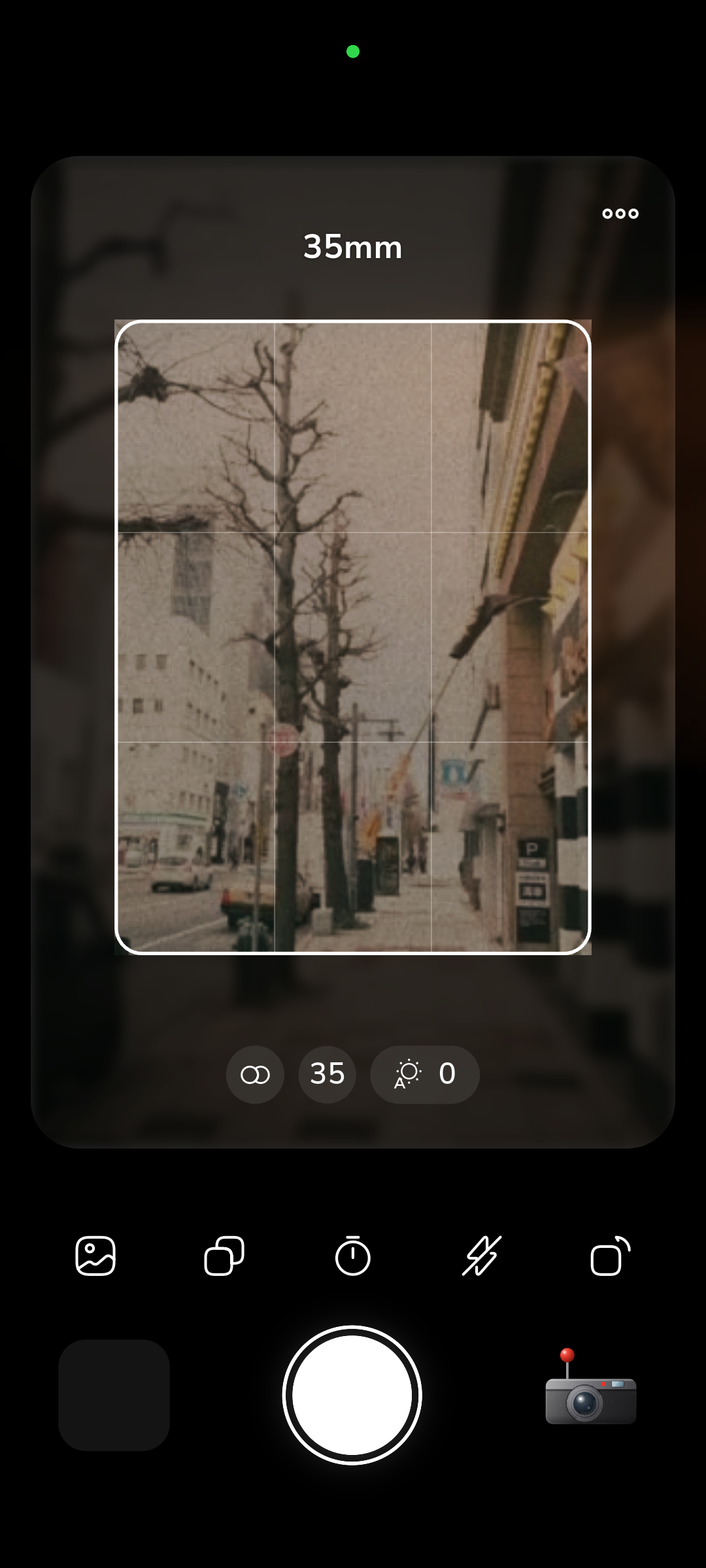
RfCamera has no leaf shutter, no winding gear, and no chemical rollers — it runs on a phone's camera sensor and a GPU. What it recreates is the pacing, not the mechanism. The live viewfinder runs a single FilmEffect pipeline: a colour matrix transform followed by a GLSL fragment shader (film.frag) that applies the optical distortions a real lens produces — barrel distortion and chromatic aberration — before layering grain, light leaks, dust, scanlines, vignette, and a date-stamp overlay on top, all in real time as you frame the shot. That live preview is not a rough draft; when you press the shutter, the app hands the same pipeline to a compute() isolate in bake.dart, which replays every one of those steps — the same colour matrix, the same shader math, the same grain and dust and leak plates — against the full-resolution capture off the main UI thread, so the final JPEG matches what you saw in the viewfinder rather than an approximation baked separately in post. The grain, leak, and dust textures in that pipeline are scans of real film stock, not generated noise, which is why the result reads as photographic rather than filtered. None of this touches a network: RfCamera declares no INTERNET permission in its manifest, so the finished photo is written straight to the app's own documents directory on the device and never leaves it unless you personally share it. The deliberate pause you feel while the isolate bakes the frame is the closest thing this app has to a winding lever — a few hundred milliseconds where the phone is doing real, verifiable work instead of returning your tap instantly.